

The European Innovation Council has opened its funding budget to European defence and dual-use innovation. This shift comes at a critical moment for Europe’s deep-tech ecosystem. Defence and dual-use technologies are being driven by a sovereign procurement super-cycle, growing European strategic autonomy priorities, record VC and growth equity appetite, and increasing M&A activity by defence primes seeking AI, cyber, autonomy, space, sensing and advanced systems capabilities … read more below
Overview
- The EIC Opens Defence & Dual-Use Funding: What Founders, Investors and Policymakers Need to Know
- A New Funding Pathway for Defence and Dual-Use Technologies
- Europe's Defence Innovation Market is being Driven by a Sovereign Procurement Super-Cycle
- The Europe-First Procurement Shift
- Why Deep-Tech Companies are Suddenly Strategic Assets
- VC and Growth Equity Appetite has Reached Record Levels
- Helsing: Europe's Defence AI Champion
- Quantum Systems: The Rise of the Dual-Use Unicorn
- Isar Aerospace: Sovereign Space Attracts Growth Capital
- The EIC Accelerator Could Transform Early-Stage Defence & Dual-Use Financing
- A Powerful Dilution Shield
- Specialist Defence-Tech Investors are Already Building the Ecosystem
- New Funds are Creating Future Growth Pathways
- M&A Activity is Accelerating as Defence Primes Race to Acquire Strategic Technologies
- The Transactions that Illustrate the Trend
- Europe's Next Defence Champions May Already be Inside the EIC Portfolio
- What This Means for Europe's Innovation Ecosystem
- Resources & Latest updates
The EIC Opens Defence & Dual-Use Funding: What Founders, Investors and Policymakers Need to Know
On 17 June 2026, the European Innovation Council (EIC) announced one of the most significant changes in its history: defence and dual-use technologies are now eligible for support under the EIC Accelerator and STEP Scale Up programmes.
The update enables companies developing technologies with both civilian and defence applications to access grants of up to €2.5 million and equity investments of up to €10 million through the EIC Accelerator, while larger scale-ups can access a dedicated €100 million EIC STEP Defence Scale Up facility offering direct equity investments of €10 million to €30 million per company.
The policy shift reflects a broader reality. Defence and dual-use technologies have become one of the fastest-growing segments of the European deep-tech ecosystem, attracting unprecedented levels of venture capital, growth equity, strategic acquisitions and public investment.
For founders, investors and public-sector stakeholders, the EIC’s announcement is therefore much more than a funding update. It is a signal that Europe is actively building the next generation of strategic technology champions.
More information about the programme is available through the European Innovation Council - https://eic.ec.europa.eu/news/european-innovation-council-opens-defence-and-dual-use-technologies-2026-06-17_en
A New Funding Pathway for Defence and Dual-Use Technologies
The EIC’s expanded framework creates two complementary funding pathways.
The first is aimed at early-stage and growth-stage dual-use innovators developing technologies across areas such as artificial intelligence, quantum technologies, robotics, space systems, cybersecurity and advanced materials.
Eligible companies can access:
- Grants of up to €2.5 million
- EIC equity investments of up to €10 million
- Additional STEP funding opportunities for larger growth rounds
The second pathway is the newly launched EIC STEP Defence Scale Up call, targeting companies developing critical defence capabilities, including:
- Air and missile defence
- Drones and counter-drone systems
- Cybersecurity and electronic warfare
- Military mobility
- Strategic enabling technologies
- Advanced defence systems
The programme will provide direct equity investments of between €10 million and €30 million and is specifically designed to participate in larger funding rounds typically ranging from €50 million to €150 million or more.
Europe’s Defence Innovation Market Is Being Driven by a Sovereign Procurement Super-Cycle
To understand the significance of the EIC’s decision, it is important to look beyond innovation funding and examine the broader policy environment shaping the European defence market.
Europe is currently undergoing what many investors describe as a sovereign rearmament cycle.
According to the European Commission’s Defence Readiness Roadmap 2030, published in March 2026, the European Union is pursuing an ambitious strategy to strengthen defence readiness, industrial resilience and technological sovereignty. The programme is supported by an estimated €800 billion defence readiness agenda and is designed to reduce Europe’s dependence on non-European suppliers while accelerating the development of strategic technologies.
The Europe-First Procurement Shift
At the centre of this strategy is a clear industrial policy objective: build more of Europe’s defence capabilities within Europe.
By 2030, the European Union aims for 55% of military procurement spending to be directed toward European industry, while joint procurement initiatives among Member States are expected to reach 40% by 2027.
For decades, a significant proportion of European defence spending flowed to non-European suppliers, particularly large US defence contractors. The new framework seeks to strengthen domestic industrial capacity and create more resilient European supply chains across critical defence technologies.
For innovative European companies, this represents a powerful long-term demand signal.
Why Deep-Tech Companies Are Suddenly Strategic Assets
The roadmap also recognises that future defence capabilities will increasingly depend on advanced technologies rather than traditional hardware alone.
Member States are being encouraged to allocate at least 10% of defence budgets to highly innovative technologies, including:
- Artificial intelligence
- Autonomous systems
- Cybersecurity
- Sensor fusion
- Robotics
- Electronic warfare
- Advanced software platforms
- Space and communications technologies
Unlike previous defence cycles, much of this innovation is now emerging from venture-backed deep-tech companies rather than traditional defence contractors.
For founders developing AI, quantum, cyber, autonomy, robotics or space technologies, the opportunity extends beyond grant funding. The combination of long-term procurement demand, growing defence budgets and increasing strategic autonomy requirements creates the potential for multi-year revenue visibility and significantly larger addressable markets.
Viewed through this lens, the EIC’s decision is not simply a funding policy change. It is part of a much broader effort to ensure that Europe’s next generation of strategic technology champions can emerge, scale and remain competitive within a rapidly changing geopolitical landscape.
VC and Growth Equity Appetite Has Reached Record Levels
One of the clearest indicators of this shift is the transformation in private capital markets.
According to a 2025/2026 McKinsey analysis, investment into European defence technology startups increased by more than 500% between 2021 and 2024 compared with the preceding three-year period.
Data from FindNStart and Sifted shows that European defence-tech companies attracted approximately $2.48 billion in equity funding during 2025 alone, representing a 38% year-on-year increase in invested capital and a 67% increase in transaction volume.
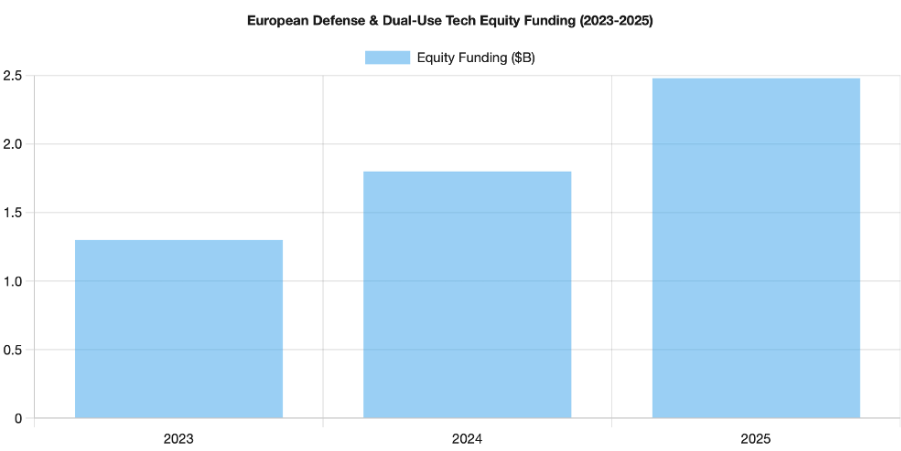
Source: FindNStart, Sifted H1 2025, and PitchBook market data. Figures reflect venture and growth equity rounds in European defense/dual-use tech.
Alongside traditional venture capital firms, sovereign and institutional investors have become increasingly active.
The €1 billion NATO Innovation Fund has reported a 32-fold increase in European defence and resilience-related deep-tech funding over the past decade. The European Investment Bank has expanded its defence financing capacity from €1 billion to €3 billion, while the EU’s Defence Equity Facility is expected to channel more than €500 million into the sector by the end of 2026.
Helsing: Europe’s Defence AI Champion
Munich-based Helsing has become the flagship example of Europe’s new defence-tech ecosystem.
Following a €600 million Series D financing round in 2025 at a reported valuation of approximately €12 billion, the company has reportedly continued attracting major international investors including Lightspeed Venture Partners and Dragoneer Investment Group at valuations approaching €18 billion.
Its growth has been reinforced by a reported €1.46 billion drone software programme linked to the German defence ecosystem.
Quantum Systems: The Rise of the Dual-Use Unicorn
German drone and aerial intelligence company Quantum Systems became one of Europe’s leading dual-use success stories after surpassing a €3 billion valuation through a €180 million Series C extension led by Balderton Capital. Total capital raised during 2025 reached approximately €340 million.
Isar Aerospace: Sovereign Space Attracts Growth Capital
Isar Aerospace secured a €270 million Series D financing round in June 2026 led by Island Green Capital and Molten Ventures to accelerate production of its Spectrum launch vehicle and strengthen Europe’s sovereign launch capabilities.
The market is also benefiting from a growing ecosystem of dedicated defence-focused investors, including the NATO Innovation Fund, the European Defence & Security Tech Fund managed by Keen Venture Partners, and the recently launched €500 million E2D (European Dual-Use & Defence Technology Fund) established by Earlybird and AVP.
The EIC Accelerator Could Transform Early-Stage Defence & Dual-Use Financing
While much attention has focused on scale-ups and €30 million equity investments, the implications for Seed and Series A companies may be equally significant.
Historically, many European dual-use startups faced a structural funding bottleneck. Founders often had to minimise defence applications in funding proposals to remain eligible for civilian programmes, while specialist investors remained relatively scarce.
The EIC’s June 2026 policy change fundamentally alters this equation.
Startups can now officially combine up to €2.5 million in non-dilutive EIC Accelerator grant funding with up to €10 million in direct EIC equity investment, creating one of the most attractive financing structures available to deep-tech companies in Europe.
A Powerful Dilution Shield
A venture capital fund leading a relatively modest €3 million Series A round could potentially combine that financing with EIC support, creating a balance sheet exceeding €15 million while substantially reducing dilution for founders and early shareholders.
For investors, this effectively creates a public-sector co-investment mechanism capable of extending runway, accelerating product development and reducing financing risk during the most capital-intensive stages of deep-tech commercialisation.
Specialist Defence-Tech Investors Are Already Building the Ecosystem
One of the most notable examples is the European Defence and Security Tech Fund managed by Keen Venture Partners.
Following a first close exceeding €150 million in late 2025, the Amsterdam-based fund expanded toward approximately €180 million after welcoming Invest-NL as an investor in April 2026.
The fund also secured backing from the European Investment Fund (EIF), which committed €40 million, alongside a €10 million commitment from ABN AMRO.
Keen actively invests in AI, cybersecurity, space technologies and autonomous systems, deploying tickets ranging from €1 million to €10 million.
A recent example is AirHub, a drone operations software platform that secured a €4.4 million Series A round in April 2026 backed by Keen Venture Partners, RunwayFBU, Lumaux and LUMO Labs.
New Funds Are Creating Future Growth Pathways
The early-stage ecosystem is also benefiting from larger dedicated growth vehicles.
A notable example is the recently launched E2D (European Dual-Use & Defence Technology Fund), a €500 million initiative established by Earlybird and AVP in June 2026.
The fund’s mission is particularly relevant given that Europe accounted for only 6.2% of NATO-wide defence-tech venture capital raised during 2025, while approximately 85% of defence-tech venture funding since 2019 has flowed into the United States.
By deploying average investments of approximately €25 million, E2D is designed to provide a domestic growth-stage pathway for promising companies graduating from Seed, Series A and EIC Accelerator-backed financing rounds.
M&A Activity Is Accelerating as Defence Primes Race to Acquire Strategic Technologies
According to White & Case’s 2026 Defence M&A analysis, Europe surpassed the United States in defence deal volume during 2025. Transaction volumes increased by 85% year-on-year to 24 completed deals, while total deal value more than doubled to approximately $1.3 billion.
Major European defence companies such as Rheinmetall, Safran, Leonardo and Hensoldt have benefited from a dramatic re-rating of the sector, with the STOXX Europe Aerospace & Defence Index gaining more than 65% during 2025.
Armed with stronger balance sheets and higher valuations, these groups are increasingly acquiring innovative technology companies to close capability gaps in artificial intelligence, cyber, autonomy, space systems and advanced sensing.
The Transactions That Illustrate the Trend
Safran’s acquisition of Preligens for approximately €220 million provided the aerospace and defence group with advanced AI-powered geospatial intelligence capabilities increasingly required in modern defence operations.
Rheinmetall’s acquisition of Loc Performance for approximately $950 million strengthened its military mobility and industrial manufacturing capabilities as European defence spending continues to increase.
KNDS’s acquisition of Texelis demonstrates how strategic buyers are securing specialised technologies to strengthen next-generation defence platforms and mobility systems.
According to Bain & Company’s 2026 Defence M&A Report, average defence-related private equity deal activity has nearly doubled over the past five years compared with the previous five-year period.
The result is a more mature exit environment for innovative companies operating in the sector.
Europe’s Next Defence Champions May Already Be Inside the EIC Portfolio
One of the most interesting aspects of the EIC’s policy shift is that many future dual-use champions may already be sitting within the EIC portfolio.
Although defence-focused applications were not formally eligible until 2026, numerous EIC-backed companies have developed technologies with clear dual-use potential.
Constellr, a German thermal Earth observation company, initially received EIC support for climate and agricultural monitoring applications before raising a €37 million Series A round to expand defence-grade thermal intelligence capabilities.
Greenerwave, a French deep-tech company developing advanced electromagnetic wave control technologies, leveraged EIC support before attracting defence-related investors and securing strategic agreements with Airbus Defence & Space and Telespazio France.
Daedalean, the Swiss developer of safety-critical autonomous aviation software, received EIC backing before being acquired by Destinus in a transaction valued at approximately CHF 180 million.
These examples illustrate an important point: Europe already possesses a substantial pipeline of dual-use innovation. The EIC’s new framework simply enables these companies to pursue defence opportunities more openly while accessing dedicated growth capital.
What This Means for Europe’s Innovation Ecosystem
The significance of the EIC’s new Defence & Dual-Use framework extends well beyond the funding itself.
It reflects the convergence of three powerful forces reshaping Europe’s innovation landscape:
- Growing investor appetite for strategic technologies
- Increasing acquisition activity by defence and industrial leaders
- A policy commitment to strengthen European technological sovereignty
For founders, this creates new pathways to scale.
For investors, it expands access to a rapidly growing category of deep-tech opportunities.
For governments, innovation agencies and economic development stakeholders, it provides a valuable signal about the technologies likely to underpin Europe’s future security, resilience and industrial competitiveness.
At Winnovart, we continuously monitor fundraising activity, investor appetite, strategic acquisitions, public funding programmes and emerging technology sectors across Europe, helping stakeholders identify opportunities at the intersection of innovation, capital and strategic growth.
The EIC’s entry into defence and dual-use funding is not simply a new call for proposals. It is a signal that Europe is building a new generation of strategic technology champions—and that the organisations able to identify them early will be best positioned to benefit from the opportunities ahead.
Resources & Latest updates
-
EIC Press release: The European Innovation Council opens to defence and dual-use technologies - https://eic.ec.europa.eu/news/european-innovation-council-opens-defence-and-dual-use-technologies-2026-06-17_en
At Winnovart, it is part of our mission to bridge the gap between government funding and venture capital in Europe.
We believe government funding plays a crucial role in creating and developing ecosystems that drive innovation, foster growth, and reduce regional disparities across Europe. The synergy between government funding and private investment has consistently demonstrated positive effects on recipient companies and their ecosystems. Our goal is to help innovative companies, private investors, and funding agencies maximize the benefits of this synergy.
We provide independent funding advisory, intelligence, facilitate access to funding stakeholders and, occasionally, engage in direct investments.
For more updates on funding opportunities, please follow us on social media: Facebook, Linkedin or Twitter.
Disclaimer: This is an independent resource provided by Winnovart, based on publicly available information. Engaging with us may result in a direct commercial proposal related to advisory services or equity investments.
|
For more details about Winnovart please check our website. If you would like to be contacted by our experts please reply to
office@winnovart.com or contact us here and we will get in touch very soon.
|