.jpg "Government Funding & Venture Capital (5)")
Insights in Europe
We analysed data spanning between 2012 and 2021 and found that Government agencies in Europe are incredibly active in the European venture capital (VC) sector.
1. Government agencies were the largest sources of venture funds in 2021
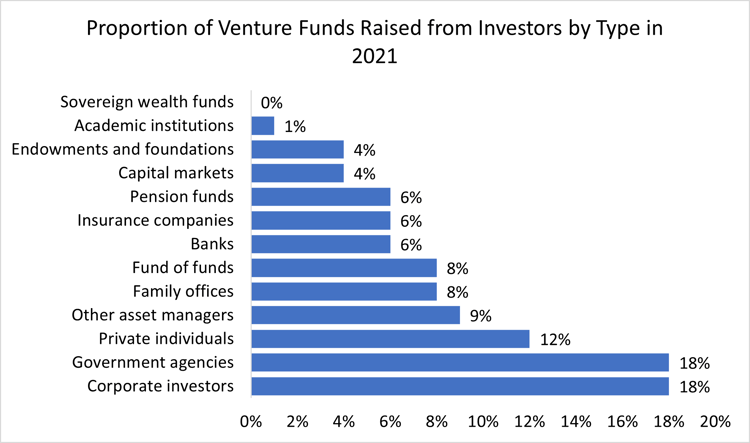
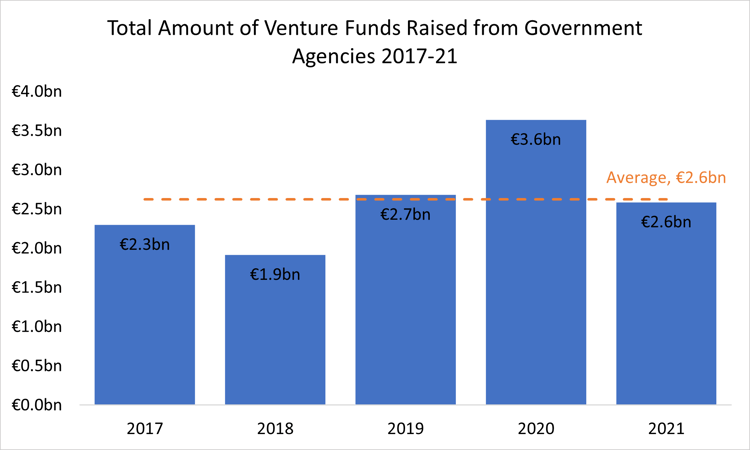
Both Government agencies and corporate investors were the largest sources of funds in 2021—each accounting for 18% of the capital raised by venture funds. The proportion of venture funds raised from Government agencies fell from 30% in 2020 to 18% in 2021. At the same time, the total value of venture funds raised increased.
Source: Invest Europe: EU Private Equity Activity (2021), p.21 – https://www.investeurope.eu/media/5184/invest-europe-activity-data-report-2021.pdf
2. Government agencies have consistently been one of the largest sources of venture funds over the past decade
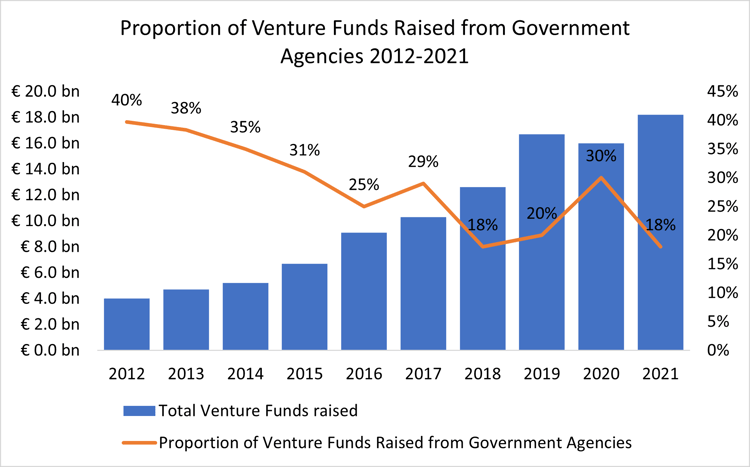
Between the years 2017 – 2021, Government agencies have consistently been one of the largest sources of venture funds. At the same time, the total value of venture funds raised has grown rapidly.
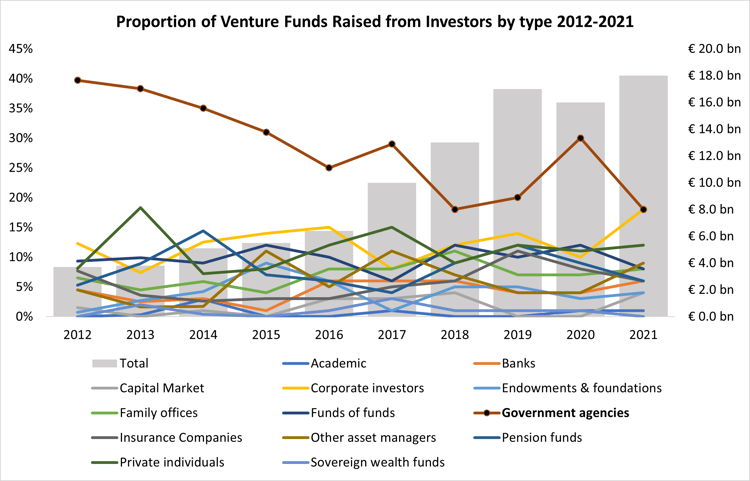
The extent of the government's impact is exacerbated when directly compared with other sources of funds, such as corporate investors, funds of funds, other asset managers, family offices, and private individuals. The graph above shows a large gap between the trendline for government agencies and the trendline for the next largest source of funds.
Source: Invest Europe: EU Private Equity Activity (2021), p.23 – https://www.investeurope.eu/media/5184/invest-europe-activity-data-report-2021.pdf
Source: Invest Europe: EU Private Equity Activity (2016), p.18 –https://www.investeurope.eu/media/1183/invest-europe-2016-european-private-equity-activity-final.pdf
3. Government agencies are more active in the venture sector than with the buyout and growth sectors
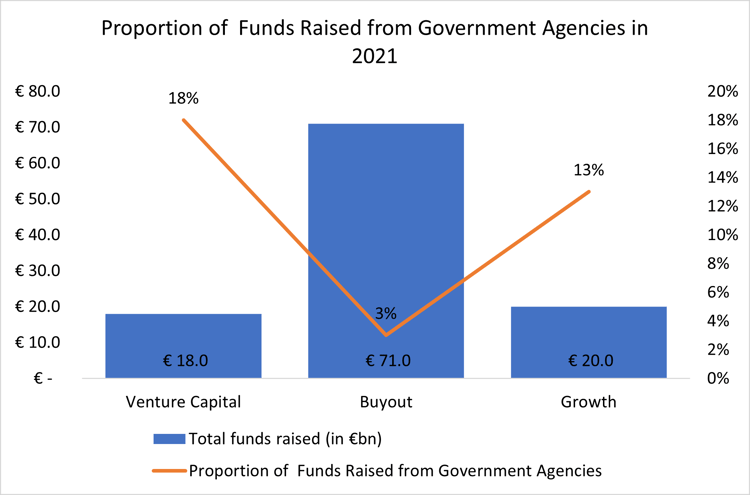
Although venture fundraising was the lowest in comparison to buyout and growth fundraising, the government had the largest impact on this sector in 2021. Government agencies sourced 18% of the total venture funds raised during the year, whereas they only sourced 3% of buyout funds and 13% of growth funds.
Source: Invest Europe: EU Private Equity Activity (2021), p.12, p.21 – https://www.investeurope.eu/media/5184/invest-europe-activity-data-report-2021.pdf
4. Historically, Government agencies have had the most impact on the venture sector
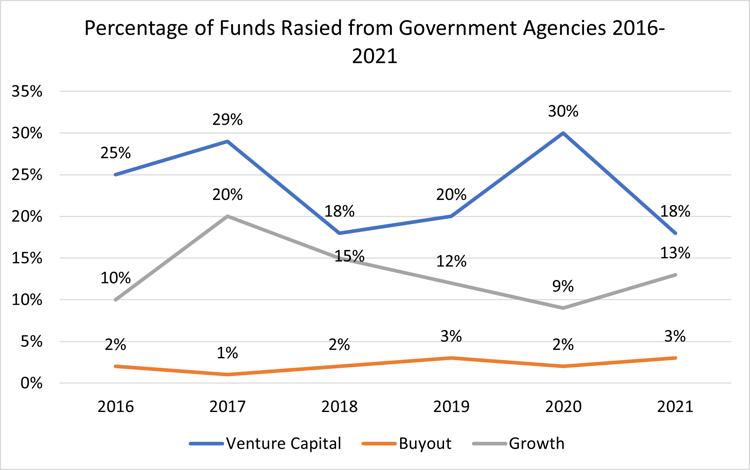
When looking at this historical data, we can capture several insights. Firstly, the Government agencies have been the most active in the venture capital sector. The percentage of funds sourced by Government agencies were 18%, 30% and 20% in years 2021, 2020 and 2019, respectively. Secondly, the government’s capital contribution to the venture capital sector has been the most volatile during the period 2016-2021. The Government’s role in buyout fundraising has been much more stable, averaging 2% since 2016.
Source: Invest Europe: EU Private Equity Activity (2021), p.21 – https://www.investeurope.eu/media/5184/invest-europe-activity-data-report-2021.pdf
Invest Europe: EU Private Equity Activity (2020), p.22 – https://www.investeurope.eu/media/4004/investing-in-europe_private-equity-activity_2020_invest-europe_final.pdf
Invest Europe: EU Private Equity Activity (2019), p.21 – https://www.investeurope.eu/media/3052/20200512_invest-europe-investing-in-europe_-private-equity-activity-2019-final.pdf
Invest Europe: EU Private Equity Activity (2018), p.16 – https://www.hvca.hu/documents/invest-europe-2018-european-private-equity-activity.pdf
Invest Europe: EU Private Equity Activity (2017), p.16 – https://www.slovca.sk/files/attachments/European%20Private%20Equity%20Activity%202017.pdf
Invest Europe: EU Private Equity Activity (2016), p.16 – https://www.investeurope.eu/media/1183/invest-europe-2016-european-private-equity-activity-final.pdf
5. Government agencies have increased their follow-on funds in venture firms
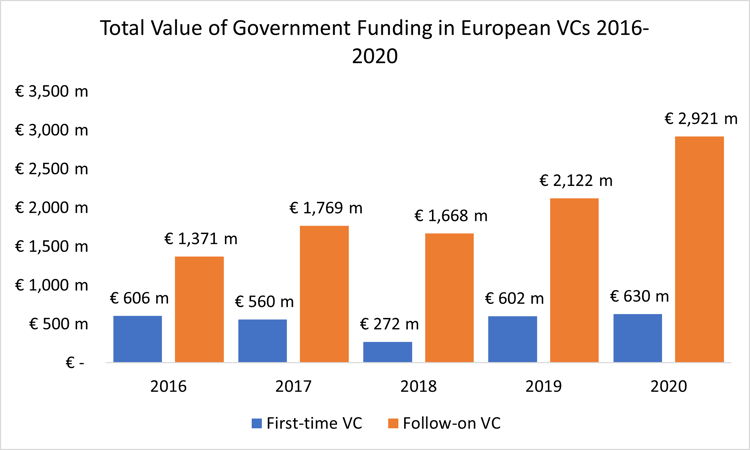
Though Government agencies have increased their follow-on funds in venture capital firms since 2016, the level of first-time funds has remained relatively stable (excluding the year 2018). There was a sharp 37% Year-on-Year (YoY) increase in the level of follow-on VC in 2020. This was likely due to the COVID-19 pandemic which caused governments worldwide to increase financial assistance to businesses.
Source: Atomico: State of European Tech (2021), p.206 – https://2021.stateofeuropeantech.com/chapter/attracting-world-class-investors/article/fundraising/1096/4718#c1096
Source: Atomico: State of EU Tech (2022) - https://stateofeuropeantech.com/1.european-teach-a-new-reality#C1-3-government-is-moving-the-needle
6. The share of funds raised from Government agencies was the highest in developing regions across Europe
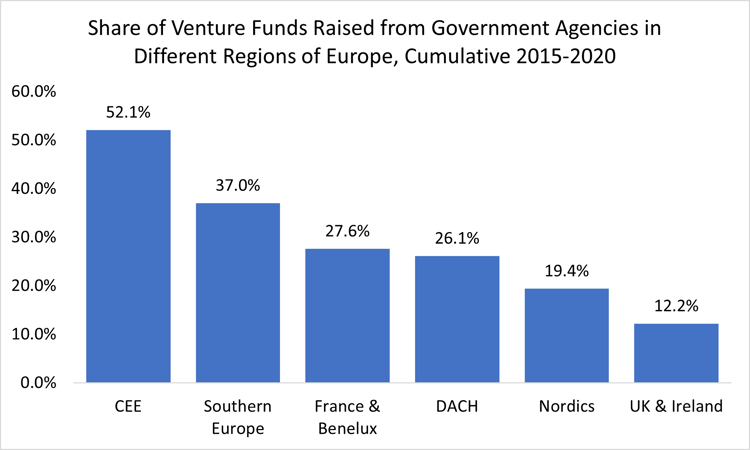
The share of venture funds raised from Government agencies in the CEE and Southern Europe regions were significantly higher than those in more developed regions in Europe. For instance, Government agencies raised 52% of venture funds between the years 2015 – 2020 in CEE compared to just 12% in the UK & Ireland.
Source: Atomico: State of European Tech (2021), p.205 – https://2021.stateofeuropeantech.com/chapter/attracting-world-class-investors/article/fundraising/217/871#c217
7. The change in the share of government funding in first-time funds was mixed across Europe
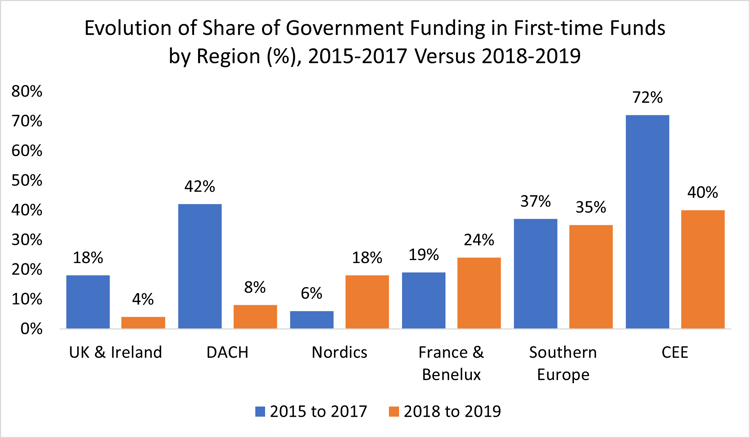
This data show mixed results. The relative share of Government agency funding in first-time funds is declining across the UK & Ireland, DACH, Southern Europe and CEE, yet it is increasing in the Nordics and in France & Benelux.
Source: Atomico: State of European Tech (2020), p.70 – https://2020.stateofeuropeantech.com/chart/464-2322/
8. The change in the share of government funding in follow-on funds was relatively stable across Europe
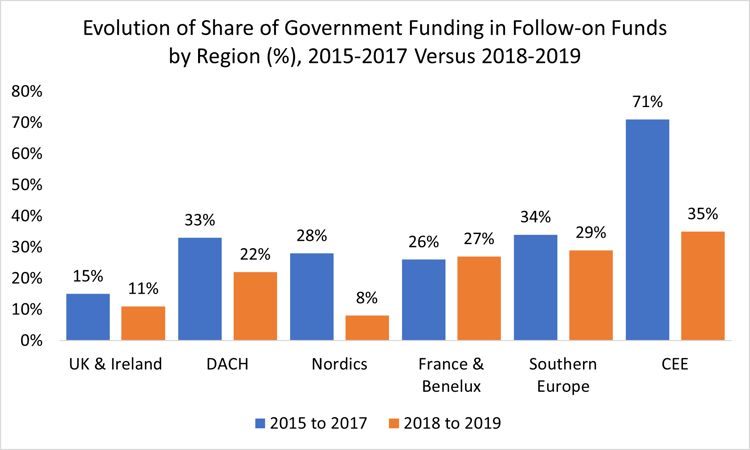
The trends in Government agency funding in follow-on funds are much more defined than that of first-time funds. The relative share of Government agency funding in follow-on funds is declining across Europe, except for France & Benelux where the evolution share of Government funding is marginally the same.
Source: Atomico: State of European Tech (2020), p.70 – https://2020.stateofeuropeantech.com/chart/464-2323/
9. France was the largest provider of venture funds in 2020 and 2021
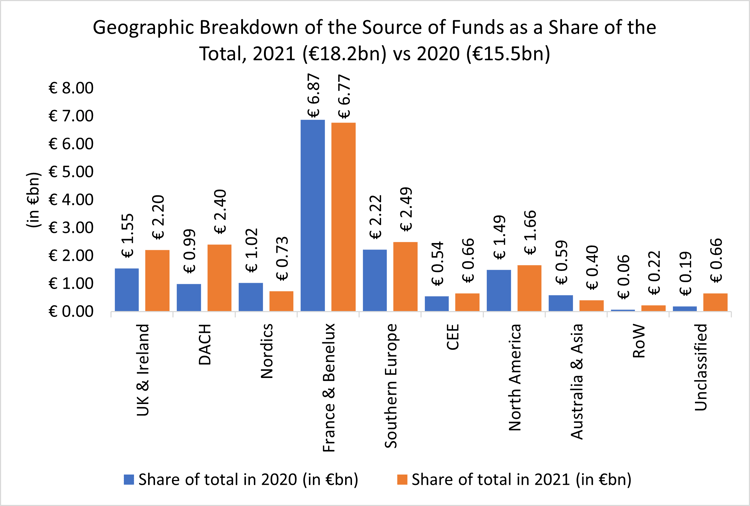
France was Europe's largest source of venture funds, supplying 38% of the total funds in 2020 and 44% in 2021. It is important to note that France has a very well-established venture sector in addition to various government initiatives that support innovation. Other major suppliers of capital were the UK & Ireland as well as DACH countries.
Source: Invest Europe: EU Private Equity Activity (2021), p.13, 27 – https://www.investeurope.eu/media/5184/invest-europe-activity-data-report-2021.pdf
Source: Invest Europe: EU Private Equity Activity (2020), p.13, 28 – https://www.investeurope.eu/media/4004/investing-in-europe_private-equity-activity_2020_invest-europe_final.pdf
10. Developed regions in Europe are struggling to obtain venture investment
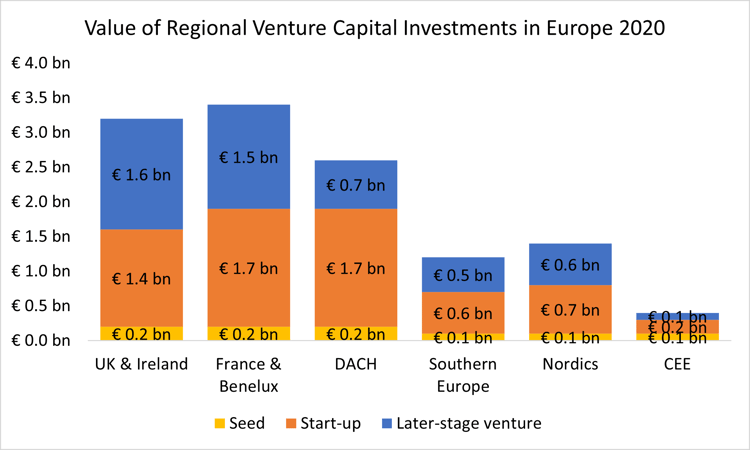
Whilst the level of venture investment is consistent across countries at the seed stage (ranging mostly between €0.1bn-0.2bn), there is a clear gap in the level of investment at the start-up and later stages. Compared to the CEE region, the level of investment in start-ups was 3 times higher in both the Nordics and Southern Europe in 2020. Furthermore, the level of investment in start-ups was as much as 8 times higher in more developed regions of Europe.
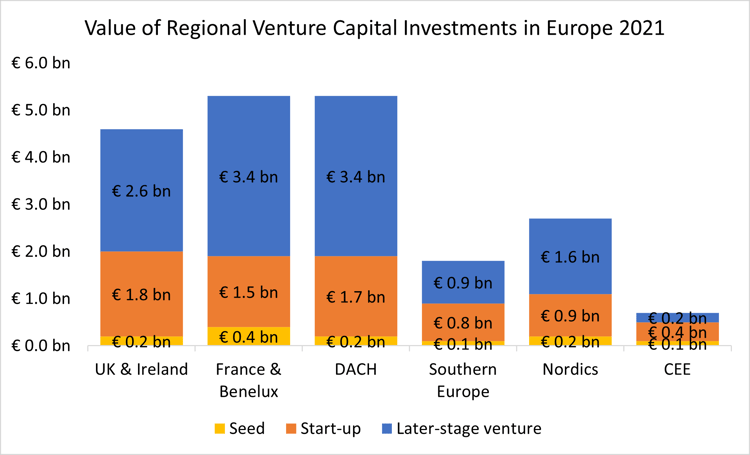
Whilst the level of investment increased in 2021, the same disparities were seen in the level of investment in start-ups and later-stage ventures across different regions in Europe.
Source: Invest Europe: EU Private Equity Activity (2020), p.50 – https://www.investeurope.eu/media/4004/investing-in-europe_private-equity-activity_2020_invest-europe_final.pdf
Source: Invest Europe: EU Private Equity Activity (2021), p.47 – https://www.investeurope.eu/media/5184/invest-europe-activity-data-report-2021.pdf
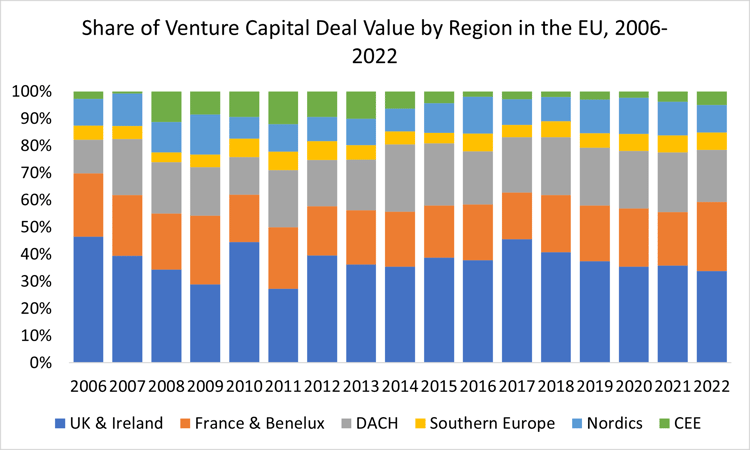
11. The UK & Ireland account for most of the venture activity in Europe
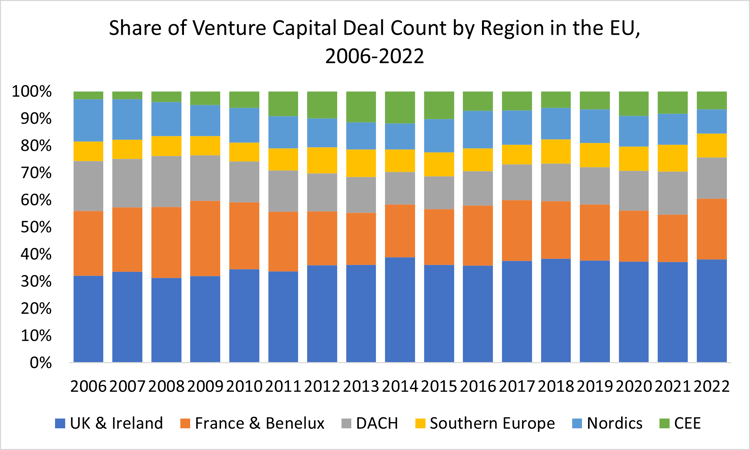
The share of venture capital deal value in the CEE region has declined since its high in 2011.
Source: European Venture Report (Q1 2022), p.7 – https://files.pitchbook.com/website/files/pdf/Q1_2022_European_Venture_Report.pdf
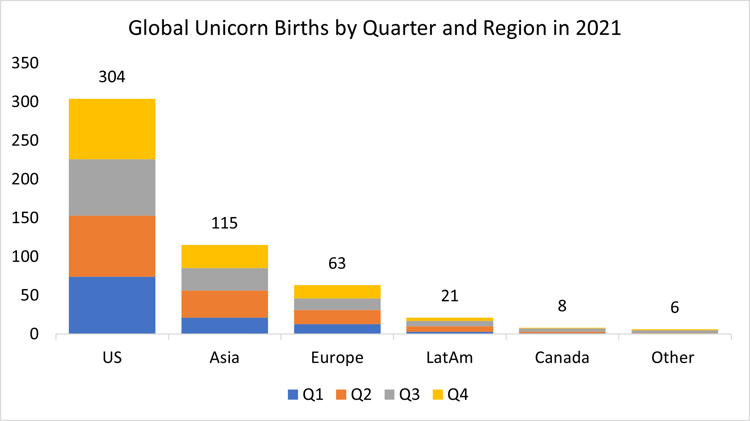
12. Europe is still lagging behind the US and Asia in terms of unicorn creation
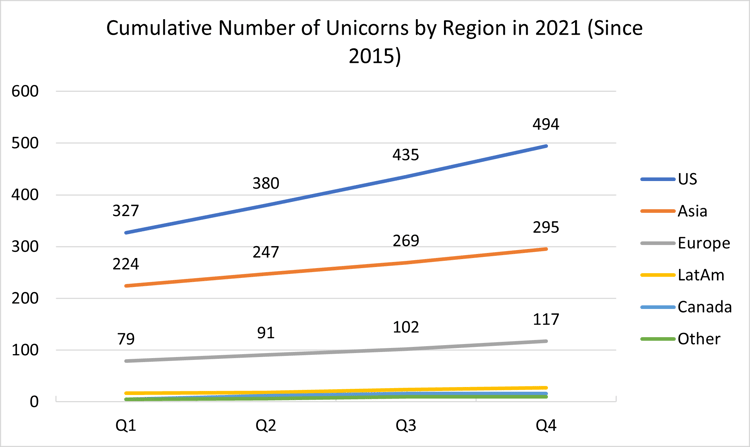
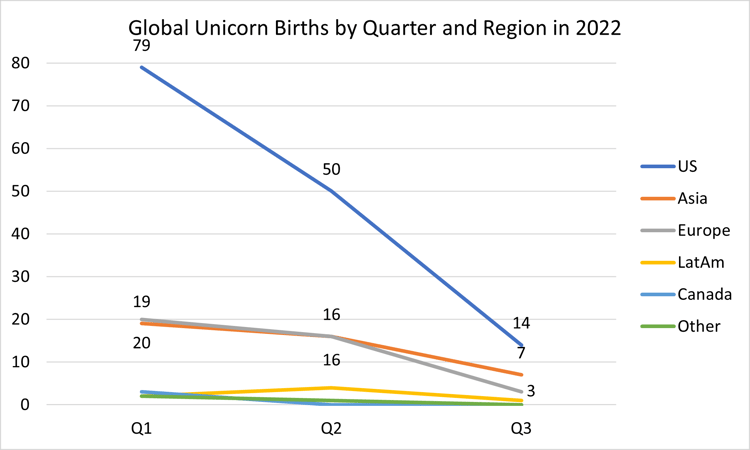
Source: CBInsights: State of Venture (2021), p.60-61 – https://www.cbinsights.com/reports/CB-Insights_Venture-Report-2021.pdf
Source: CBInsights: State of Venture (Q3, 2022), p.38 https://www.cbinsights.com/reports/CB-Insights_Venture-Report-Q3-2022.pdf?
Insights in CEE
We examine data related to the Central and Eastern Europe (CEE) venture capital sector and find companies in developing regions are not attracting significant venture investment.
1. The CEE region is heavily dependent on the government as a source of funds
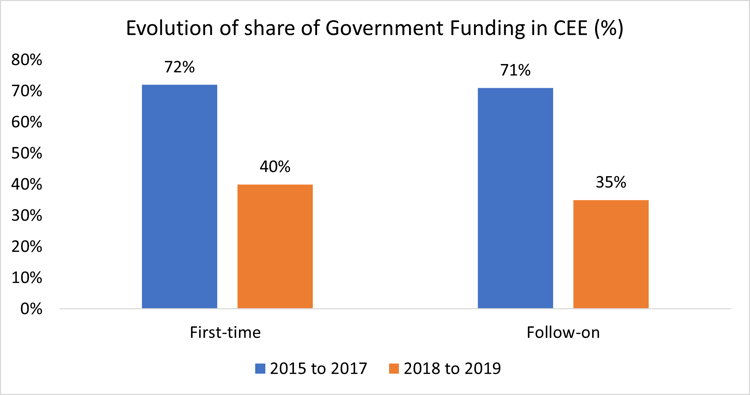
In the CEE region, there is a high dependency on government funding. The decline in the share of funds is falling slower than the rest of Europe which means that the CEE region shows a low maturity in the European venture capital market. Nevertheless, it is still declining along with the rest of Europe.
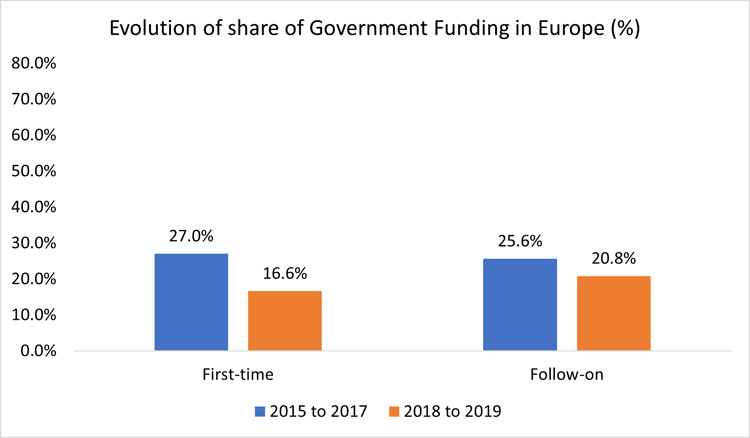
Source: Atomico: State of European Tech (2020), p.70 - https://soet-pdf.s3.eu-west-2.amazonaws.com/State_of_European_Tech_2020.pdf
2. Government agencies are very active in the CEE venture sector
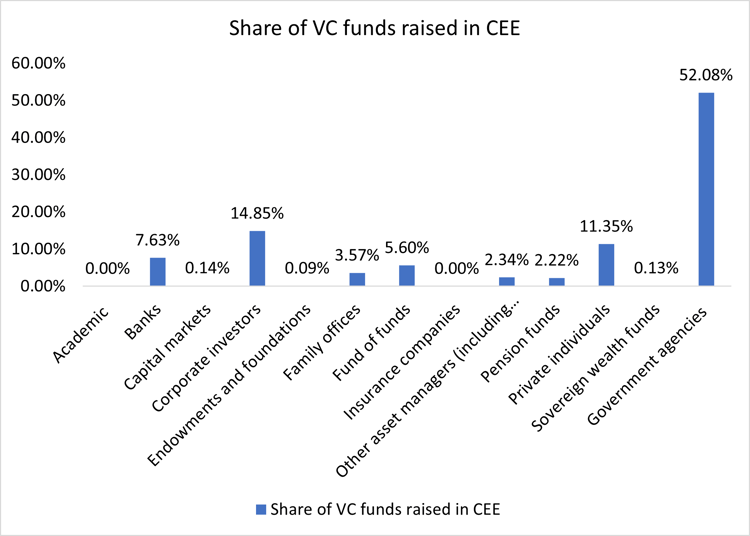
In the CEE region, 52% of VC funds were raised from Government agencies followed by corporate investors with 15%. As a result, CEE has the highest share of VC funds raised from Government agencies in Europe.
Source: Atomico: State of European Tech (2021), p.205 – https://soet-pdf.s3.eu-west-2.amazonaws.com/State_of_European_Tech_2021.pdf
3. Since the GFC, the funds raised from Government agencies have increased
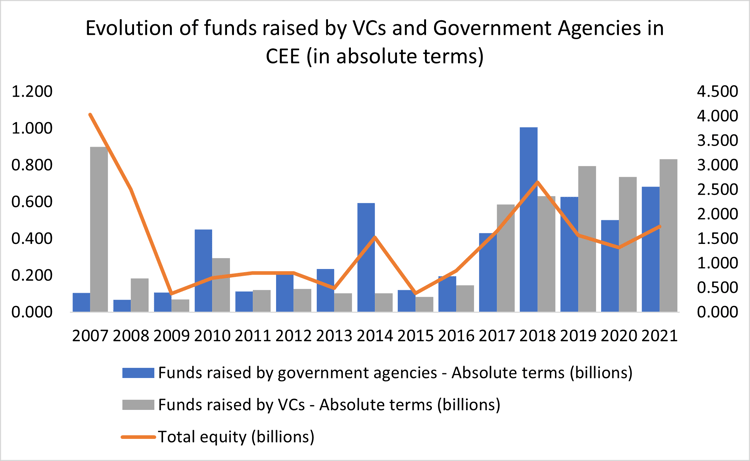
In the CEE region, €832 million in venture funds were raised which is a new record level in absolute terms, accounting for 47% of total capital raised. This is strongly supported by Government and multi-lateral agency initiatives. An upward trend can be seen since 2017 resulting in a sustained increase in VC investment activity which is expected to continue.
Source: Invest Europe: Central & Eastern Europe Private Equity Statistics (2021), p.9-13 - https://www.investeurope.eu/media/5283/cee-2021-activity-statistics-report.pdf
Invest Europe: Central & Eastern Europe Private Equity Statistics (2020), p.9-13 - https://www.investeurope.eu/media/3983/invest-europe-cee-activity-report-2020.pdf
Invest Europe: Central & Eastern Europe Private Equity Statistics (2019), p.9-13 - https://www.investeurope.eu/media/3225/central_and_eastern_europe_activity_report_2019.pdf
Invest Europe: Central & Eastern Europe Private Equity Statistics (2018), p.8-12 - https://www.investeurope.eu/media/2630/ie_cee_report_2018_final.pdf
Invest Europe: Central & Eastern Europe Private Equity Statistics (2017), p.8-12 - https://www.hvca.hu/documents/Invest-Europe-CEE-Activity-Report-2017-05072018.pdf
Invest Europe: Central & Eastern Europe Private Equity Statistics (2016), p.8-12 - https://www.hvca.hu/documents/invest-europe_cee_privateequitystatistics2016_24082017.pdf
Invest Europe: Central & Eastern Europe Private Equity Statistics (2015), p.8-12 - https://www.investeurope.eu/media/1220/invest-europe-cee-statistics-2015.pdf
Invest Europe: Central & Eastern Europe Private Equity Statistics (2014), p.8-12 - https://www.investeurope.eu/media/1239/evca-2014-cee-report.pdf
Invest Europe: Central & Eastern Europe Private Equity Statistics (2013), p.7-11 - https://www.hvca.hu/documents/_evca_bro_sp_cee2013.pdf
4. The number of companies that have received VC investment has increased by a factor of 5
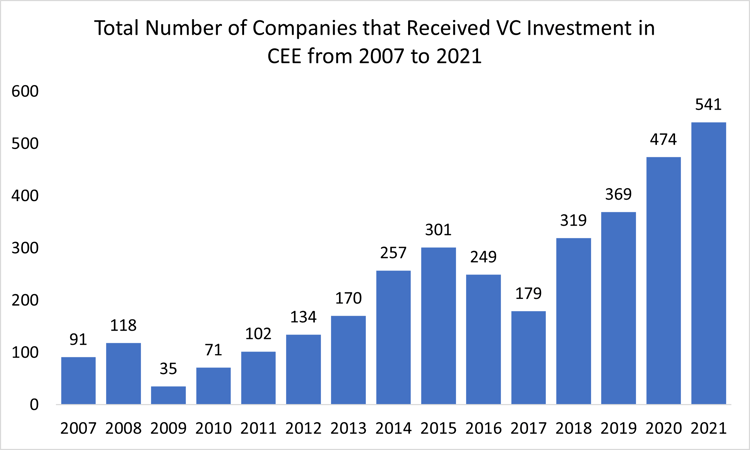
The total number of companies awarded VC investment has increased YoY 11 times during the period 2007-2020.
Source: Statista (2021) – https://www.statista.com/statistics/879064/venture-capital-investments-in-central-and-eastern-europe-by-number-of-companies/
5. In the CEE, Poland has seen the largest number of unicorns
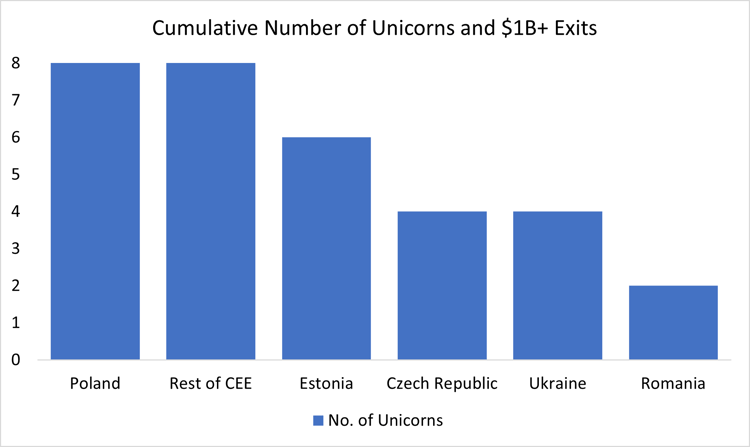
8 unicorns have been established in Poland, which is higher than any other country in the CEE region.
Source: Atomico, Dealroom & Google: Central and Eastern European startups (2021), p.11 – https://dealroom.co/uploaded/2021/10/Dealroom-report-Google-Atomico-CEE-2021.pdf?x39545
6. The majority of VC investments have taken place in Poland, Hungary and The Czech Republic
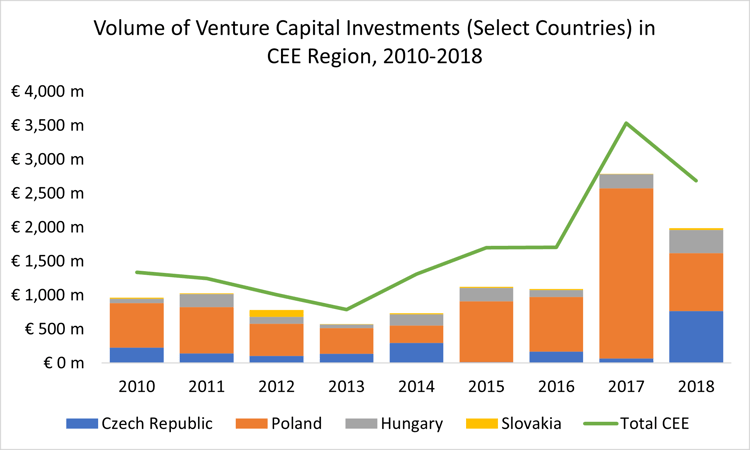
Polish companies achieved the highest level of investment in the CEE region between 2010 and 2018.
Source: Analysis of the use of venture capital in Central and Eastern Europe countries, p.4 – https://doi.org/10.1051/shsconf/20208301029
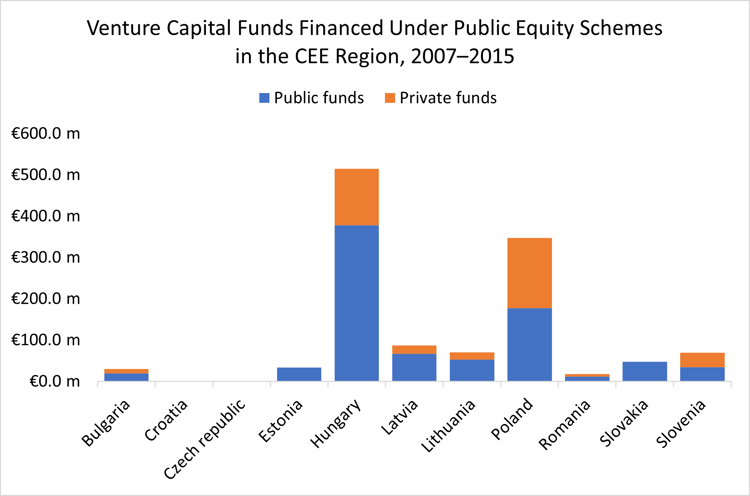
7. Venture Capital Funds Financed Under Public Equity Schemes in the CEE Region
Most of the hybrid funds in the EU were created in Hungary, overseeing more than €0.5bn in value. The second highest number of hybrid funds was created in Poland.
Source: Judit Karsai (2018) Government venture capital in central and eastern Europe, Table 1 – https://doi.org/10.1080/13691066.2018.1411040