
GVCs, PVC-GVCs, Co-investment Schemes, Blended finance. Europe & beyond
We are aiming to put together the most comprehensive list of programmes that bring together Government funding & Venture Capital. Blended finance and Investor partnership programmes mixing grants & private investment. Co-investment programmes between Government agencies and Private Investors. Government funding programmes directly for Venture Capital. At Winnovart. We believe in this synergy and we will keep raising awareness around it. We hope you will find it useful. Please contribute to our list of resources (including statistics, insights, literature review etc) ... this is work in progress ...
Overview
Introduction
Most existing studies have found evidence supporting the presence of GVC activity. Specifically, the studies seem to support the hypothesis that GVCs do not displace private VC (PVC) investment but strongly complement it. It is widely accepted that GVCs aim to foster innovation and entrepreneurship by bridging a finance and information gap.
This page provides a summary of the current public-private funding schemes across Europe and beyond. It goes beyond the typical meaning of a GVC.
Disclaimer: Winnovart is not promoting this resource to the wider public and we are only sharing it with partners in our network. The list of resources we are sharing below is , as of the latest update - March 2025 - still far from being complete. Further review and research is required. Any feedback and suggestion are most welcome and would be very much appreciated. Please reach out to GVC@winnovart.com
UK & Ireland
England, Scotland, Wales, Northern Ireland and Ireland
Enterprise Capital Fund (ECF) - UK
The ECF programme combines private and public money to make equity investments in high growth businesses. One objective of the ECF programme is to increase the availability of growth capital to SMEs and start-ups that operate in the UK. Another key objective of the ECF is to lower the barriers to entry for fund managers looking to operate in the venture capital market.
There are no restrictions on the size of the funds (e.g., minimums or maximums) that will be supported by the British Business Finance Limited (BBFL) – a wholly owned subsidiary of British Business Bank plc (BBB). However, the BBFL will not commit more than £50m in funding to any single fund.
Future Fund: Breakthrough - UK
Future Fund: Breakthrough is a £375m UK-wide scheme which will encourage private investors to co-invest with government in high-growth, innovative firms. Key features of the programme include: a £375m initial fund size, a focus on R&D intensive companies and a minimum investment round size of £30m.
Due to high research and development costs, breakthrough technology companies typically require more capital than other technology companies to fuel the later stages of their growth. Future Fund: Breakthrough is delivered by British Patient Capital a commercial subsidiary of the BBB.
The Angel CoFund makes equity investments of between £100,000 and £1 million in smaller businesses in the UK. It invests alongside strong syndicates of business angels to support businesses with strong growth potential. Investment is subject to an upper limit of 49% of an investment round and 30% of the equity in a business, although investments are usually less than this.
Performance:
- Since its inception in November 2011, the Angel CoFund has enabled smaller businesses to secure £280m in investment (as at end December 2018).
- The fund has invested and committed £41.5m, alongside a further £238m from business angels and other investors, providing support for 82 businesses (as at end December 2018).
- Every £1 invested by the Angel CoFund has leveraged around £5 from business angel syndicates. This continued strong performance places it comfortably at the upper end of the range when benchmarked against European Venture Capital for both early stage and later stage funds.
The London Co-investment Fund - UK
The scheme, delivered by Funding London and Capital Enterprise, was established with a £25M contribution from the London Economic Action Partnership (LEAP), and is supported by the Mayor of London. The Mayor maintains an equity stake in these young companies and helps them with legal, procurement, supply chain and marketing challenges.
The Fund co-invests in seed rounds between £250,000- £1,500,000, led by our selected co-investment partners.
Since inception, the Fund has invested in 150 early stage digital, science and technology businesses in London. Alongside its investment, the Fund has catalysed over £200m of private investment and has created an estimated 3,000+ new jobs.
Scottish Co-Investment Fund - Scotland
The Scottish Co-investment Fund (SCF) is designed to address a finance gap alongside our accredited co-investment partners. Investment can be made in companies from start-up, early-stage to expanding businesses seeking to develop products and/or markets.
Through the fund, SCF can:
- Match accredited investment partners up to a maximum of 50% of the total funding package on a commercial basis
- Provide from £10,000 up to £2 million, as part of a total deal size typically ranging from £20,000 up to £10 million
The Fund invests on equal terms with an investment partner. Applicants will need to secure funding from an accredited co-investment partner before the SCF look at co-investing into the company.
Core funds and Co-investment Programme - UK
Our co-investment strategy enables us to increase the size of later-stage UK funding rounds, and is a significant part of our work to achieve our vision for more homegrown and fully-funded high growth companies to fulfil their potential.
Please note that our core co-investment programme is only open to companies within our underlying portfolio. If you are an R&D intensive UK business looking for direct investment from British Patient Capital, please go to Future Fund: Breakthrough.
Life Sciences Investment Programme - UK
The Life Sciences Investment Programme (LSIP) is a £200m initiative managed by BPC designed to address the growth equity finance gap faced by high-potential UK life sciences companies. This is expected to attract at least a further £400m of private investment. The scheme has a minimum target fund size of £250m.
Through LSIP, we make cornerstone commitments to later stage life sciences venture growth funds with a strong UK focus, typically investing between £50m and £100m in each successful fund.
Development Bank of Wales - Wales
Approach as an investor: For early-stage businesses, we always look to co-invest with other equity partners, as one aim of the Development Bank is to attract private sector funding to Wales. We will work closely with the co-investment partner through the process, often sharing diligence if practical, whilst maintaining our own decision process and consent rights. The exception to this is the Angel Co-Investment Fund, which is passive. Investments from this fund we will follow the investment decisions of the lead angel investor, subject to eligibility rules.
Finance for tech ventures – Our seed finance provides equity investments from £50,000 to £250,000 to Welsh technology businesses keen to commercialise – start-ups, university spin-outs, and new companies.
Key support provided:
- Entry investment between £50,000 and £2 million
- Follow-on investments up to £5 million
- A large network of co-investors and business angels
Equity finance for growth – We can provide equity up to £10 million to businesses based in Wales or planning to move here.
Key support provided:
- Equity investment up to £10 million
- Flexible funding structure suitable for your growth plans
- Value-add investor with a strong network of non-executive directors and advisers, and co-investors
Innovate UK is the UK’s national innovation agency. We support business-led innovation in all sectors, technologies and UK regions. We help businesses grow through the development and commercialisation of new products, processes, and services, supported by an outstanding innovation ecosystem that is agile, inclusive, and easy to navigate.
Investor Partnership Programme – This programme combines Innovate UK's grant funding, and investor partner's aligned funding and expertise.
Innovate UK has a carefully curated group of investor partners who possess the ability to invest in innovative, technology-led businesses operating in sectors that align with Innovate UK's programme areas. The investor partners include venture capital funds, corporate investors, business angel groups and social impact investors, coming from across the UK, Europe, and the US.
The primary objective of this program is to encourage innovation and advancement in micro, small, and medium-sized enterprises by accelerating equity investment. Through this initiative, these companies can experience accelerated growth and development, fuelled by their commitment to innovation.
Budget: The overall budget for this programme is £80 million over three years.
Long-term Investment for Technology & Science - UK
The government will launch the Long-term Investment for Technology & Science (LIFTS) competition, providing up to £500 million to support new funds designed by institutional investors and world class fund managers, aiming to crowd billions of pounds of private investment into UK science and technology businesses.
Following a short period of industry engagement led by the British Business Bank, the government will launch a call for proposals by the end of the year to identify promising fund structures and vehicles, with the intention that funds go live as soon as possible next year.
The UK Infrastructure Bank, established in June 2021, is a new, government-owned policy bank. With a focus on financing a sustainable industrial revolution and fostering growth nationwide. The bank's mission is to collaborate with the private sector and local government to provide an impressive £22 billion in infrastructure finance.
Their objective is to enhance investment in infrastructure with a dual focus:
- Contributing towards combating climate change and assisting the government in achieving its target of achieving net zero emissions by 2050.
- Supporting regional and local economic growth by fostering improved connectivity, creating new employment opportunities, and boosting productivity levels.
British Patient Capital, established as a commercial subsidiary by the government-owned British Business Bank, is dedicated to investing an initial £2.5 billion over a span of 10 years in venture and venture growth capital. This investment will not only provide substantial support to UK companies with high growth potential but also unlock an additional £5 billion of private capital.
Since the launch, they have become the UK's largest domestic investor in venture and venture growth opportunities, managing both a funds and a co-investment programme: Life Sciences Investment Programme and Future Fund: Breakthrough.
The Clean Growth Fund, launched in 2020, supports UK innovations that cut greenhouse gas emissions or boost resource efficiency in sectors like power, transport, industry, buildings, waste, and water.
They will typically make an initial investment between £500k - £3m, mainly aimed at Seed or Series A rounds.
France & Benelux
France, Belgium, Netherlands and Luxembourg
Large Venture is a €1 Billion venture capital fund owned by BPIFrance focused on fast-growing, capital intensive and highly promising innovative companies looking to finance organic or external growth and having already raised capital.
Large Venture (seeks to promote the rise of French champions to global leadership in their markets. It invests minority stakes of a minimum of €10m, co-investing alongside current or new investors in rounds of at least c.€20m. The team focuses on technology, life sciences and green technology investment opportunities.
Key figures:
- €600m invested
- 34 portfolio companies (of which 18 are listed companies)
- 5 industrial exits and 7 partial exits
A 400M EUR match fund, allowing France to co-invest and encourage angel investing in hundreds of young deep-tech start-ups. The French Tech Seed Fund aims to leverage private investment in technology start-ups in the post-maturation stage, in particular, deep tech start-ups that are less than three years old, with the goal of network co-funding. A qualified start-up can receive a commitment of up to €250,000 from the fund.
finance&invest.brussels - Belgium
finance&invest.brussels can invest capital in start-ups, scale-ups and SMEs with investment and/or development projects. In the majority of cases, finance&invest.brussels acts as a minority shareholder alongside other family, industrial or financial shareholders.
Equity investments are aimed at any commercial enterprise with a head office or an operating unit in the Brussels-Capital Region, regardless of its size. As part of an equity investment, finance&invest can invest an amount ranging from €100,000 to €5,000,000 in the capital of a company. We generally act as a minority shareholder to complete & facilitate the company's financing chain. We invest in companies for an average term ranging from 3 to 7 years.
Dutch Future Fund (DFF) - The Netherlands
The Dutch Future Fund (DFF) is a new initiative launched by the European Investment Fund (EIF) in close collaboration with the Dutch national promotional institution Invest-NL to offer fresh funding to innovative Dutch SMEs.
Both parties agreed to commit EUR 150 million, making EUR 300 million available to invest in venture and growth capital funds that have a strong commitment to innovative SMEs in the Netherlands. It is expected that EIF, as the manager of the programme, will be able to construct a balanced portfolio of 15 to 20 funds.
Based on historical experiences with similar initiatives in the Netherlands, DFF expects that, through the crowding-in of additional private investors, it will mobilise a total of around EUR 1.5 billion in equity investments into SMEs.
Dutch Future Fund II (DFF II) - The Netherlands
The Dutch Future Fund II (DFF II) is another initiative launched by the partnership of the EIF and the Dutch national promotional institution Invest-NL.
This innovative partnership dedicates a minimum of €200 million in capital to Dutch venture capital funds (VCs), with a strong focus on improving the investment landscape for Dutch startups and scale-ups in key sectors like energy transition, deep tech, circular economy, and agrifood.
Their objective is to provide vital funding for more than a hundred Dutch startups, supporting the growth and development of these innovative ventures. With a focus on backing 10 to 12 funds, they aim to fuel the expansion of these startups.
Its predecessor, the DFF, has already committed EUR 848 million to 20 Dutch investment funds, showcasing a European multiplier of nearly 5 for every euro invested by Invest-NL.
Dutch Alternative Credit Instrument (DACI) - The Netherlands
Launched through the cooperation of Invest-NL, the Government of the Netherlands, and the EIF, DACI is a fund of funds investing in both selective and diversified debt funds, and thus, providing access to alternative sources of financing for Dutch SMEs.
The initial commitment is up to €200 million, comprising a contribution by Invest-NL and the Ministry of Economic Affairs and Climate Policy of €50 million each (an aggregate of €100 million), which is match-funded on an equal basis with EIF resources.
DACI aims to build a portfolio of up to 10 underlying selective of diversified debt funds with average investment ticket of €10 - 30 million investment per fund. At the final beneficiary level, DACI’s focusses on providing growth financing and working capital to SMEs in the Netherlands.
Nordics
Denmark, Finland, Iceland, Norway and Sweden
EAF Finland co-invests with selected experienced Business Angels into innovative Finnish early stage SMEs. Business Finland Venture Capital Ltd (BFVC) has committed EUR 15 million in the EAF Finland angel fund. The fund's size is EUR 30 million and its other investor and advisor is the European Investment Fund. The fund is aimed at experienced business angels, in support of their investments in innovative start-up SMEs.
The fund's operating model is part of the European Investment Fund's Angel Investment Programme. Six other EU countries besides Finland have funds that operate on the same principle.
The business angels make decisions about investments and exits on behalf of themselves and the fund. Co-investments are made on a 50–50 principle, meaning that the fund and the business angel will invest the same amount in the company.
In order to improve access to capital and the emergence of good management environments in the north, the government is proposing funds for a new fund with state and private capital.
Private investors shall contribute with a minimum of 50% of the investment amounts. Public sector investments are limited to a maximum of NOK 20 million. The fund was established in 2018 with a capital base of NOK 132.3 million. Investinor will manage the fund.
Criteria:
- The fund shall invest up to 50% per investment. The shareholding shall be less than 49%.
- The companies must be less than seven years old from the date of their first commercial sales Revenues linked to pilot projects or demonstration facilities are not regarded as commercial sales.
- The fund will make its investments under the same terms and conditions as the co-investors and will not claim any special consideration.
The Innovation Contracts programme offered by Innovation Norway, involves a blended mix of grants and equity investments. The grants offered by the government agency must be matched by an equity investment raised by the beneficiary company from a private investor.
This aims to stimulate innovation and value creation by reducing risk and the programme may cover up to 45% of the development costs incurred by the Norwegian companies.
The grant is available to Norwegian companies having the skills and knowledge to develop the products or services the foreign companies needs but are not available in the market.
Criteria for pilot company:
- Should be a demanding and collaborating customer that takes part in the process by providing details of requirements and testing the result.
- The collaborating customer's efforts in the project (workload and funding) should be at least 20% of total eligible project costs.
For more details, please see Innovation Norway's general innovation funding page here.
Southern Europe
Greece, Italy, Portugal, Spain
The fund was born with the aim of mobilizing up to 4,000 million euros in public-private collaboration with the Spanish venture capital sector, taking shares and signing commitments in specialized companies/funds, primarily in the following digital and artificial intelligence sectors.
The new mechanism will favour public-private partnerships and the development of venture capital, with a state share in funds and companies of up to 49%, which will increase the potential for investment in technology companies and projects.
The Fund targets:
- Scale-ups: growing companies, minimum ticket greater than 3 million euros
- Start-ups: investments of less than 1 million euros
Next Tech Fund can also carry out direct co-investment in scale ups, with a minimum size of 5 million euros and a maximum of 20 million euros under a public-private collaboration scheme. It will therefore be necessary for there to always be a professional co-investor who invests under the same conditions as the Next Tech Fund.
Venture capital in Greece - Greece
Greece operates a dedicated domestic fund structure, AKES, for private equity and venture capital, (a closed-end venture capital mutual fund (AKES), formed as a partnership). AKES is tax-transparent for domestic and non-domestic limited partners, and offers non-domestic limited partners the ability to avoid having a permanent establishment in the country. Furthermore, management fees are exempt from VAT in Greek companies.
Overall, there are 21 venture capital funds active in Greece with approximately €1.2 billion under management. The funds are all members of the Hellenic Venture Capital Association (http://www.hvca.gr/), established in 2003 in Athens.
200M Co-investment Fund - Portugal
Banco Portugues de Fomento is a state-owned banking institution with a fund, 200M co-investment fund, fully financed through the European Structural and Investment Funds.
The co-investment funds has the following objectives:
- Encourage the establishment and growth of companies in their early stages, including seed, start-up, and later stage ventures (series A and B).
- Foster the expansion of risk capital activity in Portugal by mobilising specialised national and international entities that provide financial investment, as well as valuable technical, commercial, and financial expertise to SMEs.
CEE
Bulgaria, Croatia, Czech Republic, Estonia, Hungary, Lithuania, Latvia, Poland, Romania, Slovenia, Slovakia
As a state-owned capital investor, its aims to help Hungary to reach the international innovation and start-up market as dynamically as possible. From 2019, Hiventures has expanded its financing programmes to small and medium size enterprises first, and later on to large companies as well.
Early-stage – With our venture arm, we are seeking to team up with startups who already have a minimum viable product and can show signs of early traction. Founders with a global vision are welcome anywhere, from the Baltics to the Balkans.
When it comes to our investments, we always strive to be lead investors, and we participate in multiple consecutive rounds. We are active investors. We fully commit to the partnerships we form with founders, and we are in it for the long term.
Key statistics:
- €500k - €5m Ticket size
- 8 Portfolio companies
- €100m Assets Under Management
Growth-stage – We are looking for digital, future-proof stories where we can see growth potentials exceeding industry averages. We are seeking teams with an interesting past and a global vision, a team that has realistic long-term goals and a path leading to them. Our goal is to generate a significant international revenue-growth for the companies joining our portfolio, due to successful investment and our professional support. During the investment, we become partners, and we consider the realization of a carefully detailed exit-strategy our mutual success.
Key statistics:
- €500k-15m Ticket size
- 9 Portfolio companies
- €150m Assets Under Management
Invega (Lithuania) venture capital funds: Accelerator Funds, Baltic Innovation Fund, Baltic Innovation Fund II, Business Angels Co-Investment Fund, Co-Investment Fund, Co-Investment Fund for, Transport and Communications, Co-Investment Fund II, Development Fund I, Development Fund II, Early Stage and Development Fund I, Early Stage and Development Fund II, MILInvest.
Accelerator funds – The Accelerator Fund is implemented through the fund of funds Business Financing Fund that is financed from the European Regional Development Fund. The manager of the fund of funds is Invega and its founders include the Ministry of Economy and Innovation, the Ministry of Finance and Invega. The Business Finance Fund is financed from the EU funds under the Operational Programme for the EU Funds’ Investments in Lithuania in 2014–2020.
The funding amount allocated by European Regional Development Fund (ERDF) equals 13.47 million euros. In total, together with private investors, The Accelerator Fund amounts to 16.36 million. euros. Eligible applicants include micro and small enterprises.
Business Angels Co-Investment Fund – Business Angels Co-Investment Fund is intended to finance the diversified portfolio of co-investments with business angels and other private investors made from the seed to development stage.
Business Angels Co-Investment Fund is funded by the European Regional Development Fund (ERDF). The preliminary funding amount allocated by the State equals EUR 10.23 million. Eligible applicants include micro, small and medium-sized enterprises.
Micro, small and medium-sized enterprises can apply for investments directly to Business Angels Co-Investment Fund. Enterprises will be able to attract investments up to EUR 600.000 from the fund itself with an additional investment from business angel, which in total shall not be less than 50 % of the total investment size.
Co-Investment Fund – The objective of the measure is to invest in companies with high growth potential that develop or implement new products or technologies, with a special focus on businesses that develop, implement or intend to implement technological eco-innovations that mitigate the negative effects of climate change and greenhouse effect.
The maximum investment amount is up to 1.6 million euros. If the company is registered in Vilnius, Kaunas or Klaipėda, the fund’s investment may not exceed 70%. If the company is registered outside Vilnius, Kaunas or Klaipėda, the maximum funding is up to 80%. Eligible applicants include micro, small and medium-sized enterprises (SMEs) registered in the Republic of Lithuania.
The Ministry of Economy and Innovation has allocated 15 million euros for investments from the funds returned to and returnable to the INVEGA fund.
The Ministry of Investments and European Projects (MIPE) has established a new financing initiative in collaboration with the European Investment Fund (EIF) named 'Innovation Romania.' This programme is backed by a total of 106.7 million euros and is supported by the Smart Growth, Digitalisation and Financial Instruments Program 2021-2027 (PoCIDIF), funded by European Structural funds.
This initiative will launch three types of equity funds:
-
-
Technology Transfer Fund - enhancing the impact of research and innovation outcomes through collaborations with research and development organisations.
- Co-investment fund with "business angels" - seeks to boost the network of private investors and encourage their participation in advancing Romanian entrepreneurship.
- Entrepreneurship Acceleration Fund - focused on stimulating early-stage businesses and fostering their development.
-
Ukraine Export Credit Pilot - Ukraine
A new €300 million export credit guarantee facility under InvestEU SME Competitiveness window to support exports by European companies to Ukraine.
The new initiative aims to reduce financial risks with the backing of the EIF, promote EU businesses to increase exports to Ukraine and revitalise trade, strengthen ties with the EU, and contribute to Ukraine's economic recovery.
Export credit agencies as main public facilitators of trade are acting as the EIB's financial intermediaries under this pilot.
Recovery Equity Fund of Funds of Bulgaria - Bulgaria
In December 2022, the Republic of Bulgaria entrusted the EIF with the management of this new equity instrument which is now known as the Recovery Equity Fund of Funds (REF) of Bulgaria. This aims to support local businesses with access to equity finance leveraging EU resources.
The REF invests into underlying funds managed by financial intermediaries (fund managers) that are selected by the EIF's standard procedures.
The objective of the REF is to provide access to finance to Final Recipients in the form of equity or quasi-equity investments through three windows:
- Innovation Window - enhance companies' ability to innovate and speed up their productivity advancements towards a knowledge-based economy.
The window has a budget of EUR 67.5 million. - Growth Window - further development and growth of companies. The window has a budget of EUR 67.5 million.
- Infrastructure Window - focusing on investments that mainly support climate neutrality and accelerate the green and digital transformation in key sectors. The window has a budget of EUR 27 million.
Romania Recovery Equity of Fund of Funds - Romania
In December 2021, the Government of Romania, represented by the Ministry of European Investments and Projects, entrusted the EIF with the management of this new equity instrument which is now known as the Recovery Equity Fund of Funds (REF). This aims to support local businesses with access to equity finance leveraging EU resources.
The objective of the REF is to provide access to finance in the form of equity and quasi-equity for SMEs, mid-caps (companies with up to 3,000 employees), including start-ups, companies in early, advanced growth and expansion stages, and infrastructure projects focused, among others, or renewable energy and energy efficiency.
The PFR Ventures is the Development Finance Institution dedicated to fund investments. They are part of the Polish Development Fund (PFR), fully owned by the Government of Poland.
The VC Hub is looking for experienced Polish and international fund managers who can provide valuable expertise and strategic investment to Polish tech companies aiming to expand in global markets.
The types of funds available are early-stage VC, later-stage VC and growth capital. The PFR will commit the minimum of EUR 5 million with up to 30% of the fund size.
The funds must invest at least twice the PFR's commitment in Polish companies.
PFR Otwarte Innowacje - Poland
The PFR Ventures is the Development Finance Institution dedicated to fund investments. They are part of the Polish Development Fund (PFR), fully owned by the Government of Poland.
The programme functions within a fund-of-funds structure. It targets teams interested in managing a Venture Capital fund that concentrates on investing in technological projects with an R&D element, developing technologies rooted in the open innovation model.
-
Standard structure model - The contribution of PFR OI (between PLN 45 and 85 million) on the fund level, but not more than 60% of fund capitalisation. The private investors contribute a minimum of 40% of the capitalisation. The fund capitalisation starts from PLN 75 million.
-
Co-investment model - The contribution of PFR OI (between PLN 45 and 80 million) on the fund level, but not more than 97% of fund capitalisation. The contribution of the managing entity (responsible for acquiring private investors on a deal-by-deal basis) ranges from 3 - 20% of the fund capitalisation. The private investors contribute a minimum of 40% of the capitalisation. The fund capitalisation starts from PLN 46 million.
The PFR Ventures is the Development Finance Institution dedicated to fund investments. They are part of the Polish Development Fund (PFR), fully owned by the Government of Poland.
The programme will specifically focus on supporting local management teams that specialise in or would like to start investing at a later stage (post-seed rounds) who can provide valuable expertise and strategic funding to Polish companies.
The maximum investment of PFR KOFFI in one VC fund is PLN 80 million (up to 60% of the fund size).
The PFR Ventures is the Development Finance Institution dedicated to fund investments. They are part of the Polish Development Fund (PFR), fully owned by the Government of Poland.
The programme is seeking a management team that want to finance environmentally friendly and innovative companies.
The maximum contribution from PFR Green Hub FoF is up to PLN 80 million. Funds being considered are growth equity and late-growth stages.
The management team will be offered in either standard sales (based on a commitment) or co-investment (deal-by-deal) models.
EU4Buisiness Capped Guarantee - Ukraine
The EIB and EIF worked with the Directorate-General for Neighbourhood and Enlargement Negotiations within the European Commission to secure 40 million euros.
The EU4Buisiness Capped Guarantee is aiming to support SMEs in Armenia, Azerbaijan, Georgia, Moldova, and Ukraine by deploying a new capped portfolio guarantee.
The fund will be allocated to the SMEs through financial intermediaries. The EIF is accepting applications for financial intermediaries until 30 April 2025.
Western Balkans Enterprise Development and Innovation Facility - Bulgaria, Croatia, Serbia, Slovenia
The Western Balkans Enterprise Development and Innovation Facility is an EU funded program which is designed to make funds available to SMEs in the Western Balkans, as well as support services for private sector development, to support socio-economic development and EU accession across the Region.
The WB EDIF provides funding to financial intermediaries which allocate the funds to the SMEs in the Western Balkans. The funds are in the form of venture capital.
The WB EDIF Guarantee Facility provides funds in the form of guarantees to financial intermediaries for three programs: Serbia Window, Youth Employment, and Guarantee 4 SME Resilience.
The deadline to apply as a financial intermediatory is 31 December 2025.
DACH
Austria, Germany, Switzerland
BMH Beteiligungs-Managementgesellschaft Hessen mbH, headquartered in Wiesbaden, was established in 2001 and operates as a fully owned subsidiary of Landesbank Hessen-Thüringen Girozentrale (Helaba).
Playing an active role in the economic progress of Hesse, BMH collaborates with the Economic and Infrastructure Bank Hessen (WIBank). As a medium-sized investment and venture capital firm, BMH consolidates public investment interests and financing tools for early-stage, growing, and medium-sized companies in Hesse.
Currently, BMH oversees seven investment funds with a total investment value of approximately 125 million euros. Since its inception, BMH has invested in over 500 companies. The primary sectors of interest include software & IT, life sciences, mechanical and plant engineering, industrial goods, professional services, and e-commerce.
Bayern Kapital is a subsidiary of LfA Forderbank Bayern, making it a venture capital company of the Free State of Bavaria. They partner with private investors who can quickly and effectively support innovative start-ups and scale-ups from all over Bavaria with equity financing.
They manage a total of around 700 million euros and, since its founding, has financed more than 300 Bavarian high-tech start-ups.
Pro FIT - Projektfinanzierung - Germany
Investitionsbank Berlin (IBB) operates as a development bank within the state of Berlin, dedicated to improving the overall quality of life in the city. Through tailored support initiatives, IBB helps local businesses with targeted financing options and grant schemes designed to encourage growth and innovation.
Pro FIT offers funding in the form of grants and loans specifically tailored for technological innovation projects. Businesses can access loans of up to 1 million euros and grants of up to 400,000 euros, with financing options covering up to 80% of the total amount. Additionally, online financing is available for project-related research and development expenses.
Criteria:
- SMEs can apply independently or in collaboration with other companies or research institutes.
- Non-SMEs are required to partner with SMEs and research institutes.
- Research institutes must work together with at least one company based in Berlin or have an independent facility in the city.
European Union
EU Member States and countries associated to the Horizon Europe programme.
The European Innovation Council (EIC) Fund is the investment vehicle of the EIC Accelerator programme - the European Commission's flagship innovation funding programme. With a budget of €3 billion from 2021-2027, the EIC Fund is positioned to be one of Europe's largest deep-tech venture capitalists (VCs) during this period. Through the structure of the fund, a minimum of €3 billion of private funds will be invested alongside the EIC Fund during this period. The EIC aspires to crowd in a further €30bn-€50bn as one of its six strategic goals.
The EIC Fund is a venture capital fund owned by the European Commission (EC) established to make direct equity investments in companies with breakthrough technologies. The Fund usually targets minority ownership stakes (10 to 20%). Furthermore, it participates in direct equity investment ranging between €0.5 million to €15 million in innovative companies that pass the rigorous EIC Accelerator selection process. The Fund invests on a matching (1:1) basis alongside a syndicate of lead investors from the private market.
The European Commission adopted the 2025 work programme of the European Innovation Council. It opens funding opportunities worth over €1.4 billion for strategic technologies and scaling up companies. One of its novelties is the EIC STEP Scale-Up initiative. The total budget earmarked for the new EIC STEP (Strategic Technologies for Europe Platform) Scale Up in 2025 is €300 million.
The EIC STEP Scale Up aims to support promising companies driving innovation in critical areas/high-risk innovations and help them secure larger equity funding, that cannot be fully financed by other investors, for further scaling.
Climate and Infrastructure Funds
The EIF is looking to invest in projects that are primarily about climate action and environmental sustainability.
The call for expression of interest is open to investment funds, fund-of-funds (including managed accounts and other contractual arrangements), and special purpose vehicles, whether already established or to be formed. Eligible participants must invest exclusively in funds aiming for equity-level returns by deploying capital through equity and quasi-equity instruments, such as subordinated debt and mezzanine financing.
The deadline to apply as a financial intermediatory is 30 June 2027.
InvestEU Capacity Building Investments
The CBI funds are available to financial intermediaries that are in need of risk capital. The financial intermediaries must be operating in the microfinance, social enterprise finance and/or skills, education and training finance spaces that is able to provide financing to or and/or serving the Target Areas of Microfinance, Social and Skills Guarantee. They also must be operating in an EU member state.
The deadline to apply as a financial intermediatory is 30 June 2027.
The EIF must allocate 10 billion euros to financial intermediaries to invest in the European market.
Under InvestEU Equity, the EIF will offer equity investments and co-investments in collaboration with funds operating in venture capital (including business angels), private equity, and private credit (including fund-of-funds and cross-over funds). These funds may follow generalist, specialised, or mixed investment strategies. Their objectives should align with one or more thematic and/or horizontal policy priorities.
Additionally, Payment-by-Results investment schemes and social impact bonds are eligible under the Social Impact initiative.
The funds must be invested in EU member states and the deadline to apply as a financial intermediatory is 30 June 2027.
InvestEU Portfolio Guarantee Products
InvestEU portfolio guarantee products facilitate investments aligned with the EU’s policy priorities for the 2022-2027 period. The EIF offers credit risk protection through portfolio (counter-) guarantees to selected financial intermediaries.
These guarantees, provided in either capped or uncapped forms, partially cover the credit risk associated with eligible debt financing transactions extended to predefined categories of final recipients within the designated portfolios.
Financial Intermediaries must be in the EU member states and must apply by 30 June 2027.
Criticism of GVCs and Co-investment Schemes
Invest-NL Fund
(Article) Invest-NL fund has mostly gone to foreign companies:
- Only 161 million euros out of the 500 million euros spent so far by government fund Invest-NL have gone to Dutch companies
- Several MPs have criticized the fund's spending: The goal was to make a social impact and support the Dutch economy.
- All funds that receive money must commit to investing twice the amount in the Netherlands.
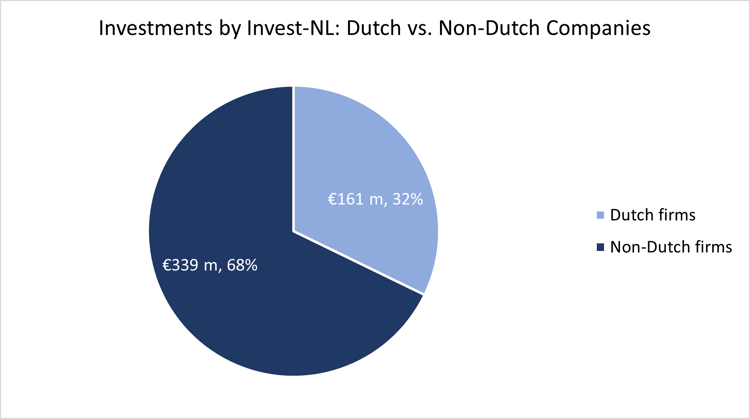 * As of 30/04/2022
Future Fund
(Article 1) UK’s government investment fund largely backed ‘zombie businesses’:
- Dharmash Mistry, a non-executive director, said that “most of the companies in the [Future Fund] portfolio had . . . limited chance of growth to a sufficient scale for success” and would therefore become “zombie businesses”.
- BBB initially assumed in March 2021 that the probability of default by the companies that received Future Fund convertible debt from the government was 54 per cent.
- The government did no commercial due diligence, but relied on the judgment of co-investors.
- The BBB highlighted data published by Horsley Bridge, a private equity investor, showing that typically more than half of early-stage investments made a loss. More than 60 per cent of returns came from just 6 per cent of investments.
(Article 2) The UK government’s venture fund has a problem — with failure and success:
- The BBB has now published the names of the 400 companies where the government’s convertible loans have flipped to an equity stake — a disclosure it previously said could not be made because of commercial confidentiality.
- But the government has said little about the two-thirds of companies where loans have not yet been converted. There is no performance data.
- Questions posed by author: Is success just covering its costs? Or does it [Future Fund] aim to generate a decent return?
- Fund was not originally pitched as a classic venture punt in pursuit of a handful of stars generating huge returns. It was meant to “protect” already-promising businesses, with a structure designed to de-risk investments with the government piggybacking on third-party investors’ expertise.
- There is also uncertainty over whether the government has the capacity to get the best from its star performers.
(Article 3) The government’s Future Fund won’t help UK startups:
- Whoever came up with the package failed to understand that the vast majority of early-stage UK funding is powered by SEIS/EIS (Seed Enterprise Investment Scheme/Enterprise Investment Scheme). The scheme, as it stands, is incompatible with SEIS/EIS.
- Worse, even if you persuaded an angel investor to invest without SEIS/EIS for this investment to help your company in this time of need, the SEIS/EIS rules would preclude them from ever getting SEIS/EIS again in your company, so that investor is lost for future rounds.
- Some of the deal terms are awful, the sort of thing a VC’s lawyers would come up with and your lawyers would tell you to never agree to. Except here there is no lawyer on your side, it’s take-it-or-leave-it, with the government, for no good reason, including deal terms that see a 2X pay-out to the investors and the government if the company doesn’t do another funding round before the convertible note hits the 3-year maturity date.
Innovate UK
(Report 1) A deep-dive into Innovate UK activity and the impact on companies receiving funding:
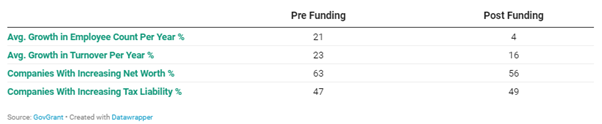
- By our analysis they are unsuccessful at positively impacting companies that they invest in, in three out of four of the key measures of company impact that we determined should display some form of impact: Employee Count, Turnover, Net Worth, and Tax Liability.
- The summary figures can be found in the table below.
- The table shows that on average Innovate UK has been unsuccessful at improving the trajectory of companies they have invested in, in three out of four of the key measures of company impact.
(Article 1) Wales Business Awarded Nine Times Less Innovate UK Funding, than Top UK Regions:
- Research conducted by intellectual property services experts GovGrant has found that businesses in Wales received just 2.83% of Innovate UK funding since 2004. This the third-lowest sum of all UK regions and nine times less investment than the best-funded areas.
- Using key performance measures identified by GovGrant, research found that innovation investment in Wales can have a significant impact.
Resources
- https://www.beauhurst.com/blog/innovate-uk-grants-equity-accelerators/
- Beauhurst report - Funding Innovation / Impact of equity and grant finance
- https://vauban.io/post/can-governments-really-be-good-venture-capitalists
- https://eic.ec.europa.eu/system/files/2022-08/EIC%20Board%20input%20to%20ITRE%20report%20on%20EIC%20implementation%20-%20August%202022.pdf
- https://nltimes.nl/2022/04/30/invest-nl-fund-mostly-gone-foreign-companies
- https://innovationorigins.com/en/invest-nl-spending-1-7-billion-for-the-energy-transition-and-innovative-scale-ups/
- https://doras.dcu.ie/22958/1/Owen%2C%20North%2C%20MacanBhaird1.pdf
- Winnovart report - A summary of relevant statistics: Government funding impact on VC
- Winnovart review of relevant (scientific) literature on GVC
- Winnovart survey results - what is the best form of government support to VC
More information
Click here to learn more about the largest public-private investment scheme in Europe.
At Winnovart, it is part of our mission to bridge the gap between stakeholders of the grants-funding market-space across Europe. We believe in the potential of grants to create ecosystems that drive innovation, growth and reduce disparities between the regions of Europe. Our aim is to support innovative SMEs, private investors and funding agencies to become part of this ecosystem and make the most of it.
Our presence in Western, Eastern and Northern Europe enables us to create international business cases for our clients, in the context of attractive funding programmes as well as beyond it, by opening up international development opportunities.
For more updates on funding opportunities, please follow us on social media: Facebook, Linkedin or Twitter.